LOTHA COMMUNITY CELEBRATES TOKHU EMONG IN DIMAPUR; LEADERS STRESS UNITY AND CULTURAL PRESERVATION
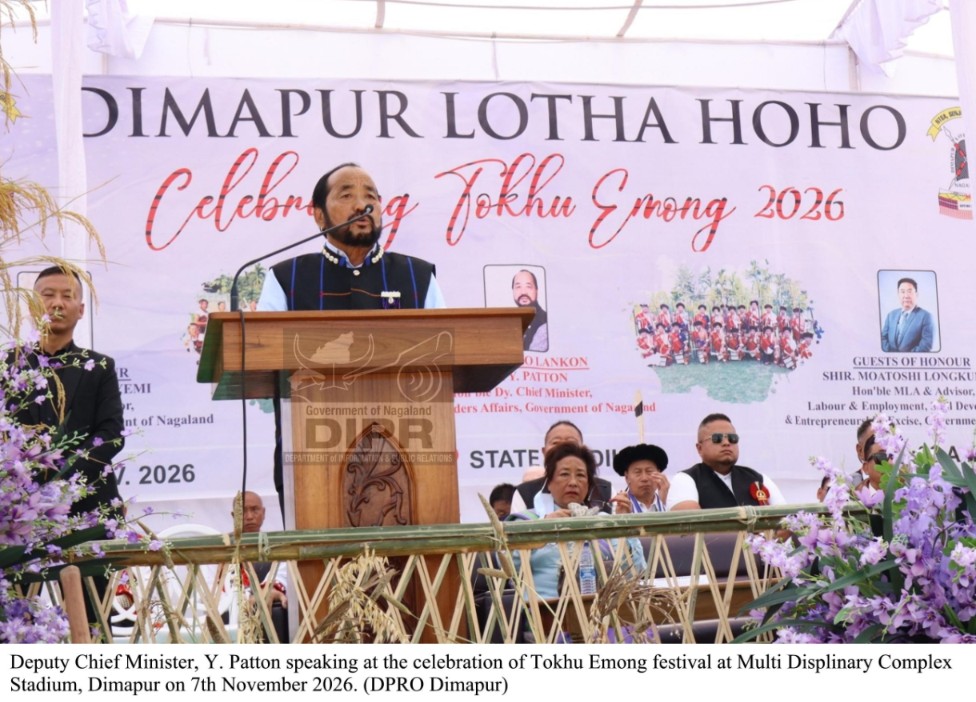
DIMAPUR, November 7: The Lotha community in Dimapur celebrated its traditional post-harvest festival, Tokhu Emong, at the Multi-disciplinary Complex Stadium on Saturday, with community leaders and public representatives calling for greater unity, preservation of cultural identity and collective progress.
Organised by the Dimapur Lotha Hoho (DLH) and hosted by Deputy Chief Minister Y. Patton and family, the celebration was attended by Advisor for Tribal Affairs and Election H. Tovihoto Ayemi and Advisor for Labour and Employment, Skill Development and Entrepreneurship, and Excise, Moatoshi Longkumer, as guests of honour. Legislators, government officials, representatives of various Naga tribes and organisations, community leaders and well-wishers also attended.
Addressing the gathering, Patton extended Tokhu greetings and said the festival was not merely an occasion for feasting and celebration but also a time to thank God for good health, protection and the blessing of witnessing another year. He described Tokhu Emong as an occasion for reconciliation, forgiveness and reflection, urging the community to resolve misunderstandings and work together towards a better future.
Patton suggested that the Lotha community consider organising a collective festival celebration once every three or four years instead of holding separate celebrations annually. Such an initiative, he said, would strengthen relationships and provide opportunities for people to know one another better. He also urged the community to reciprocate the cooperation and participation extended by other communities during their respective celebrations.
On the Naga political issue, Patton stressed the need for unity among the different Naga groups, stating that the Government of India would not provide separate solutions to the numerous factions. He called upon all groups to come together and coordinate their efforts, emphasising that a collective approach was essential to move forward.
Expressing concern over the growing problem of donations and extortion in Dimapur, Niuland and Chümoukedima, he identified demands for donations as one of the major sources of extortion and called for collective efforts to address the issue in the public interest.
On education, Patton encouraged students to aim higher and pursue their ambitions through hard work rather than studying merely to obtain academic qualifications. He also cautioned the younger generation against the misuse of mobile phones and called for responsible use of technology.
Emphasising the importance of preserving the Lotha language and cultural identity, Patton expressed concern that many members of the community, particularly younger people in Dimapur, were unable to speak their mother tongue. He urged parents to teach their indigenous language to their children at home and encouraged the younger generation to uphold traditional attire, customs and cultural practices.
He further stated that Chief Minister Neiphiu Rio had taken serious note of the need to preserve and promote indigenous culture, adding that cultural preservation should not be limited to the Hornbill Festival but should also be encouraged through initiatives such as the Mini Hornbill Festival.
Speaking as a guest of honour, Longkumer highlighted the hard work, enterprise and determination of the Lotha community, saying its achievements were the result of years of sacrifice, perseverance and commitment.
He said the community had earned its place through its enterprising spirit, particularly in venturing out, building livelihoods, establishing businesses and creating opportunities for the next generation. He noted that its achievements were reflected in its businesses, willingness to explore new opportunities and the courage of its youth, many of whom had moved beyond their homeland to seek employment and build careers.
Longkumer said the harvest celebrated during Tokhu Emong was not limited to what the land produced but also represented what a community achieved through years of hard work and determination. The prosperity of the Lotha people, he said, had been earned through their own efforts and deserved to be celebrated with pride.
He acknowledged that the community’s achievements were a source of pride not only for the Lothas but also for the wider Naga society, noting its significant contribution to the progress of Dimapur and the larger Naga community.
Emphasising the responsibility of public representatives, Longkumer said efforts must be made to build a Nagaland where young people could find opportunities, businesses could grow and the hard work of communities could translate into lasting progress. He congratulated the Lotha community and expressed hope that the festival would strengthen unity, renew determination and inspire the younger generation to carry forward its spirit of enterprise.
Ayemi, in his address, described Tokhu Emong as the traditional post-harvest festival of the Lotha Nagas, marking a time of thanksgiving, renewed friendships, sharing happiness and setting aside grievances.
Highlighting the traditional theme of the festival, ‘Englan-tso’, meaning reconciliation, unity and beauty, Ayemi said its message remained relevant to all communities and underscored the importance of forgiveness and peaceful coexistence.
Addressing two major concerns facing Naga society, Ayemi called for a balance between tribal identity and the larger Naga identity. He said village, clan and tribal affiliations provided a sense of belonging and helped preserve cultural heritage, but excessive tribalism in politics, employment and social relationships could weaken the collective strength of the Naga people.
He stressed that tribal pride should not come at the expense of Naga unity, asserting that all tribes were branches of the same tree and that the collective Naga identity must remain strong.
On modernisation, Ayemi cautioned against the gradual erosion of indigenous culture and traditions in the pursuit of progress. While education, technology and urbanisation were necessary, he observed that indigenous languages, oral traditions and traditional institutions were increasingly being neglected.
He expressed concern that younger generations were gradually replacing their indigenous languages with Nagamese and English, and called upon parents to take responsibility for preserving their mother tongues by speaking them at home.
As a way forward, Ayemi advocated stronger inter-tribal platforms to promote cooperation and mutual understanding, the preservation of indigenous languages and a critical evaluation of customary practices. He also called for the removal of regressive practices that hinder social equality and restrict women’s participation in decision-making.
He urged people to choose unity over division and consciously preserve their cultural heritage while embracing positive changes.
The programme began with an invocation prayer by Rev. Thebemo Yanthan, Senior Pastor of Lotha AG Church, Dimapur, and AGEI General Superintendent. This was followed by the presidential address delivered by DLH Chairman Thungchanthung Murry. The blessing prayer was offered by LBCD Senior Pastor Rev. Dr. Yanbemo Lotha.
A Tokhu song was presented by Vungu Von, while Dimapur Nkonjan N/Longidang Ekhung presented a folk dance. The vote of thanks was delivered by DLEE Chairperson and Tokhu Committee member Mhabeni Humtsoe. Rev. Fr. John Nchumbemo Kikon of Don Bosco Higher Secondary School, Dimapur, proposed the benediction prayer. (Tovikali, IA, Dimapur)