HIGHLIGHTS OF UNION BUDGET 2026–27
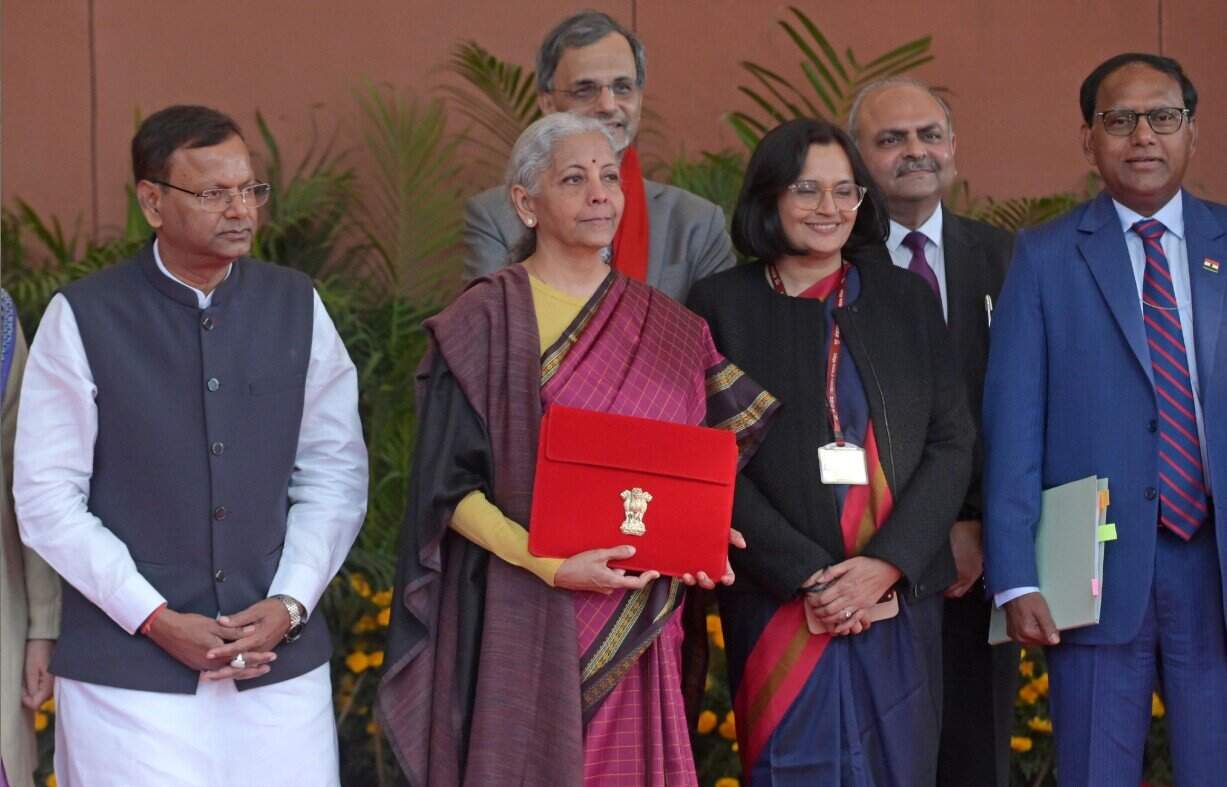
NEW DELHI, FEB 1: Union Finance Minister Nirmala Sitharaman on Saturday tabled the Union Budget 2026–27 in Parliament, outlining a reform-driven roadmap guided by three national “kartavyas” — accelerating growth, fulfilling people’s aspirations, and ensuring inclusive development in line with Sabka Sath, Sabka Vikas.
The first Budget prepared at Kartavya Bhawan focuses on economic expansion, people-centric growth, and equitable access to resources, while proposing major reforms across manufacturing, infrastructure, taxation, digital services, education, healthcare, agriculture, and governance.
BUDGET ESTIMATES
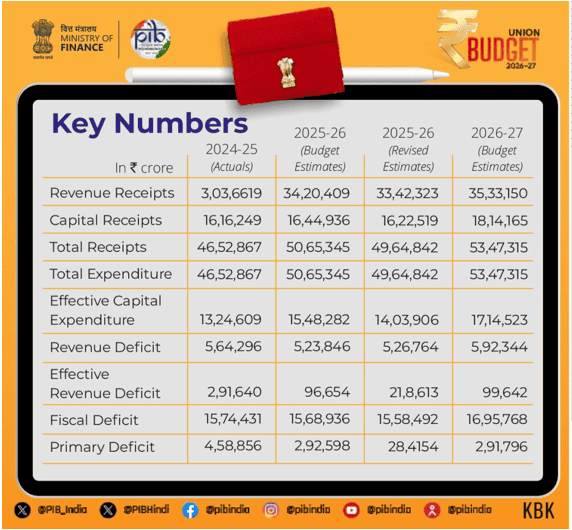
The Budget estimates non-debt receipts at Rs. 36.5 lakh crore and total expenditure at Rs. 53.5 lakh crore. The Centre’s net tax receipts are pegged at Rs. 28.7 lakh crore.
Gross market borrowings are estimated at Rs. 17.2 lakh crore, while net market borrowings from dated securities stand at Rs. 11.7 lakh crore.
The fiscal deficit for 2026–27 is projected at 4.3 percent of GDP, compared to 4.4 percent in 2025–26.
The debt-to-GDP ratio is estimated at 55.6 percent.
FIRST KARTAVYA: ACCELERATING ECONOMIC GROWTH
To scale manufacturing in seven strategic sectors, the government announced:
• Biopharma SHAKTI with an outlay of Rs. 10,000 crore over five years.
• Launch of India Semiconductor Mission (ISM) 2.0.
• Increase in Electronics Components Manufacturing Scheme outlay to Rs. 40,000 crore.
• Establishment of Rare Earth Corridors in mineral-rich States.
• Three dedicated Chemical Parks through a challenge route.
• Hi-Tech Tool Rooms, Container Manufacturing Scheme, and Construction Equipment Manufacturing Scheme.
An integrated textile programme includes the National Fibre Scheme, Textile Expansion and Employment Scheme, Mega Textile Parks, and the Mahatma Gandhi Gram Swaraj initiative.
A scheme to rejuvenate 200 legacy industrial clusters was also announced.
To promote MSMEs, the government introduced a Rs. 10,000 crore SME Growth Fund and added Rs. 2,000 crore to the Self-Reliant India Fund.
INFRASTRUCTURE PUSH
Public capital expenditure will rise to Rs. 12.2 lakh crore.
An Infrastructure Risk Guarantee Fund will be set up to attract private investors.
New Dedicated Freight Corridors will connect Dankuni to Surat.
Twenty new National Waterways will be developed over five years.
Seven high-speed rail corridors will link major cities including Delhi–Varanasi and Chennai–Bengaluru.
ENERGY, URBAN AND FINANCIAL REFORMS
An outlay of Rs. 20,000 crore was announced for Carbon Capture technologies.
City Economic Regions will receive Rs. 5,000 crore each over five years.
Municipal bond incentives were announced for large cities.
A High-Level Committee on Banking for Viksit Bharat will be formed.
SECOND KARTAVYA: BUILDING HUMAN CAPACITY
A High-Powered Education to Employment and Enterprise Committee will be set up.
100,000 Allied Health Professionals will be trained in five years.
Five Regional Medical Hubs will be created.
Three new All India Institutes of Ayurveda will be established.
Creative Technology Labs will be set up in schools and colleges.
Tourism, sports, education and cultural heritage projects will be expanded.
THIRD KARTAVYA: INCLUSIVE DEVELOPMENT
Farmer income support through reservoir rejuvenation and high-value crops.
Bharat-VISTAAR, an AI-based agri platform, will be launched.
Divyangjan Kaushal Yojana will provide employment-linked training.
NIMHANS-2 will be set up in north India.
Special focus will be given to the Purvodaya States and North-East, including Buddhist Circuits and tourism hubs.
DIRECT TAX REFORMS
A new Income Tax Act will come into effect from April 2026.
Interest awarded by MACT will be tax-free.
TCS and TDS rates will be rationalised.
Single-window tax filings, simplified returns, and automated certificates will be introduced.
Penalties and prosecution will be rationalised to reduce litigation.
SUPPORT FOR IT & GLOBAL INVESTMENT
All IT and ITeS services will be merged under “Information Technology Services” with a 15.5 percent safe harbour margin.
The threshold will rise from Rs. 300 crore to Rs. 2,000 crore.
Foreign cloud service providers using Indian data centres will receive tax holidays till 2047.
INDIRECT TAX SIMPLIFICATION
Customs duties will be reduced for critical minerals, clean energy, aviation, electronics, and defence manufacturing.
Tariff rates for personal imports will drop from 20 percent to 10 percent.
Customs clearance will be digitised and AI-enabled for faster trade.
The Union Budget 2026–27 signals a shift towards innovation-driven growth, inclusive development, and global competitiveness, while strengthening India’s journey towards Viksit Bharat.